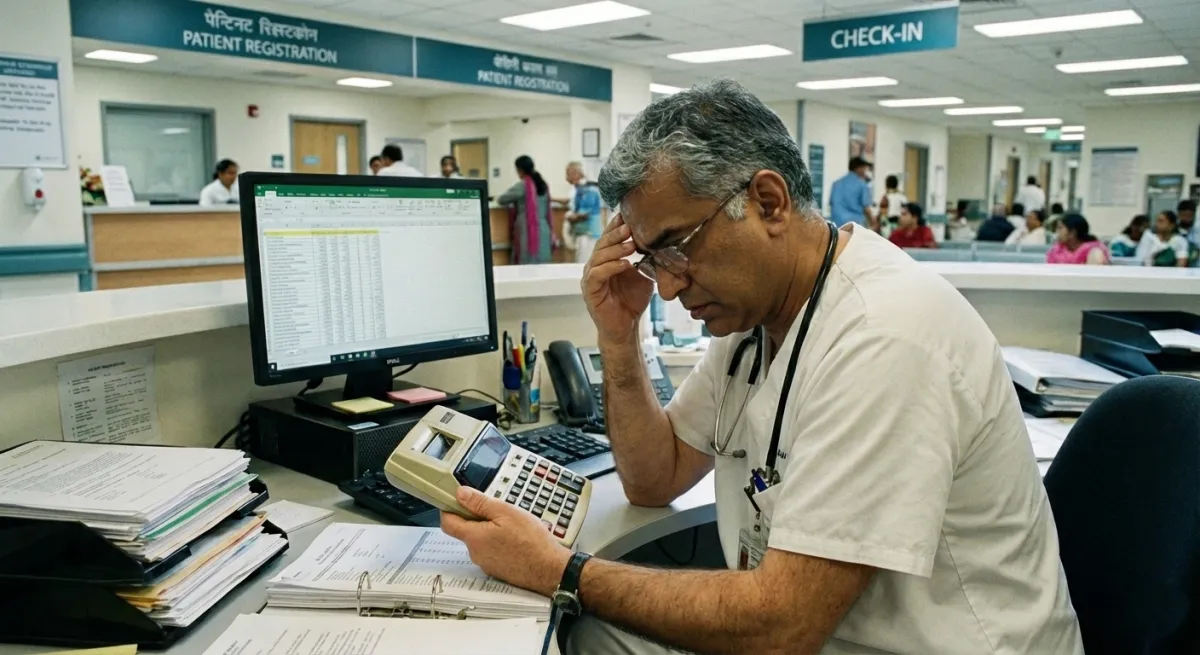
It is 11 am. The waiting room is full, and the same question reaches the front desk for the fortieth time today: "How much longer?"
Nobody at the desk knows. The doctor is with a patient. One scan is running late. Someone who was told to come with a full bladder has been holding it for an hour. A patient who arrived later has just been called in, and three people want to know why.
Most clinics try to fix this by working faster. That helps a little. But listen to what patients actually ask: how long, am I next, where do I go, have I been forgotten. Those are not questions about time. They are questions about information.
A wait has two parts
Every wait is made of minutes and of uncertainty. David Maister described this in 1985 in The Psychology of Waiting Lines, and his observations hold in any clinic:
- An uncertain wait feels longer than a known one.
- An unexplained wait feels longer than an explained one.
- An unfair wait feels longer than a fair one.
- Empty time feels longer than time spent doing something.
You can remove only so many minutes from a busy OPD. You can remove almost all of the uncertainty. The five outcomes below are the ones we built for at Arogyam.ai, in the order a patient meets them.
1. Patients arrive booked and prepared
The outcome: fewer unanswered calls, and no wasted visit because someone ate breakfast before a fasting scan.
The wait starts before the patient reaches you. It starts when they call and nobody picks up, or when they arrive and learn they should have come on an empty stomach.
Patients already message clinics on WhatsApp, often after closing time. CarePro, the WhatsApp front desk from Arogyam.ai, answers on your clinic's own number, offers only the times you have opened for booking, and confirms the visit. In clinics that set up visit types and rooms, the confirmation also carries the instruction for that visit: no food for four hours, come with a full bladder, bring your referral slip and earlier reports.
You write each instruction once, for each type of visit. Every patient then gets the right one, in writing, at the moment they book. Your staff see every chat and can step in at any point.

2. The order is fair, and everyone can see it
The outcome: emergencies are seen first, and the front desk stops refereeing.
Nothing sours a waiting room faster than someone going in "out of turn." Usually there was a good reason. Nobody explained it.
On the Today board, every arrival gets a place in the queue and moves through the same steps: Waiting, Vitals & Billing, With Doctor, Reports Ready, Treatment Plan, Complete. When someone needs to be seen urgently, the front desk marks the arrival as an emergency and it goes to the top. Everyone else keeps the order in which they arrived.
The rule is simple, and the board applies it the same way every time. When a patient asks why someone went ahead, your staff have a one-line answer instead of an argument.
3. Every room has its own line
The outcome: no names shouted down a corridor, and a bottleneck you can see before it becomes a crowd.
A single queue works when there is one doctor and one door. It breaks the moment a visit has steps: a scan, then a second scan, then a talk with the doctor, then the report.
The new room-based setup gives each step its own lane: Reception, each of your rooms, Counselling, and the Report desk. A patient's card sits in the lane where they are waiting, and staff move it in one action when the patient is called in or sent on. It also handles the cases a paper list cannot:
- A patient can wait for two rooms at once.
- Stepped out marks someone who has gone for tea, so nobody loses their place or shouts their name.
- Needs another sitting sends a patient away with a time to return, the same day or another day.
- A large-screen view puts one room's line on a display inside that room.
You decide the rooms, their hours, and which type of visit goes to which room. The board follows your clinic, not the other way round.
4. The patient's phone tells them the next step
The outcome: fewer walk-ups to the desk, and instructions that arrive when they matter.
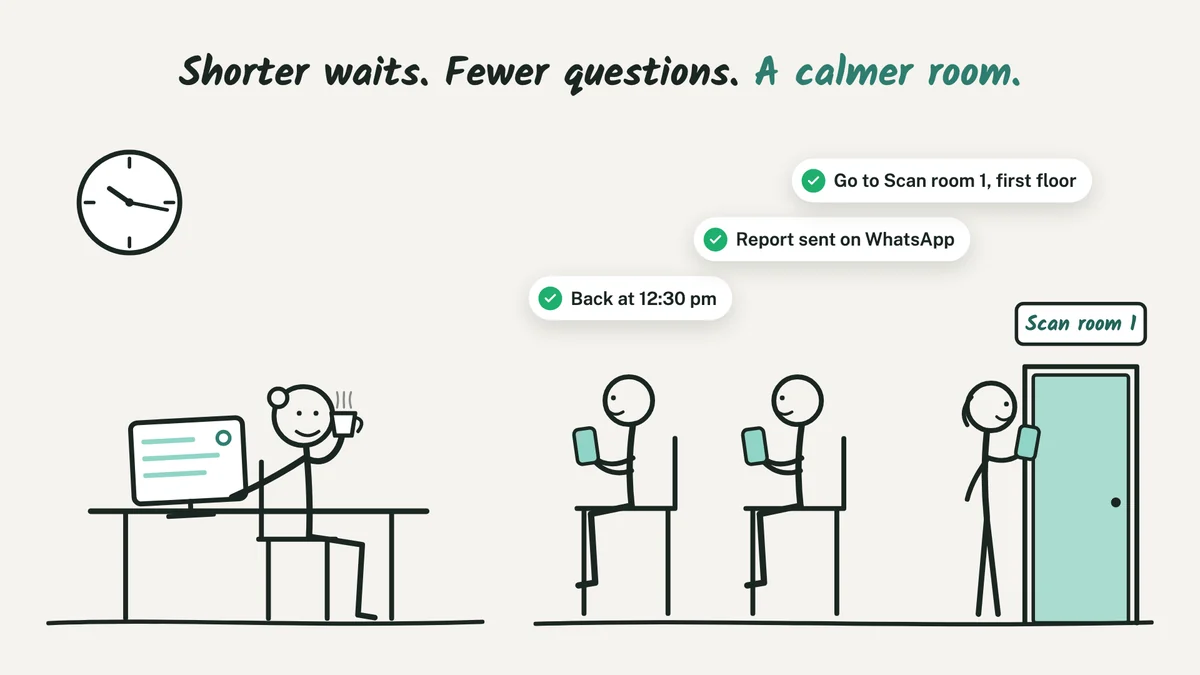
This is the part patients notice. When staff move a card to a room, the patient gets a WhatsApp message from the clinic's own number: please go to Scan room 1, first floor. If that visit has an instruction for this moment, it travels with the message: keep your bladder full until the scan.
The same thing happens at the other steps:
- Sent to counselling: please proceed to the counselling room, the doctor will discuss your reports shortly.
- Asked to come back later the same day: we will see you again at 12:30 pm, with whatever the patient should do in the meantime.
- Report ready: the report arrives on WhatsApp as a document, so nobody waits an hour for a printout.
Now the wait is known, explained and occupied. The patient who would have stood at the desk asking "which room?" is reading it on their phone. The card on the board shows Told on WhatsApp, so staff know the message went.
Some rules we held ourselves to:
- Messages go from your clinic's number, in fixed wording that WhatsApp has approved and that you can read in your settings.
- Automatic messages go only to numbers known to be reachable on WhatsApp.
- Reminders and follow-ups each have their own switch, and all of them start switched off.
- Anything clinical, such as a report, leaves only when a person presses send.
5. The conversation continues after the visit
The outcome: fewer missed appointments, and referring doctors who hear back.
A visit does not end at the door. A reminder goes out before the next appointment. When the doctor sets a follow-up date, the patient is reminded as it approaches. And when a patient was referred by another doctor, a short summary letter can go to that doctor on WhatsApp, once they have agreed to receive it.
None of this adds work at the desk. It replaces the phone calls that used to do the same job, when someone remembered to make them.
What this is not
It is not a countdown clock. We do not tell patients "12 minutes," because nobody can keep that promise in a clinic. We tell them what is true: where to go, what to do, and when to come back.
It is not a replacement for your front desk. CarePro joins your team. Your staff still decide who moves where. The software makes sure the patient hears about it.
Three things to try this week, with or without software
- Write down the three questions patients ask your front desk most often. Those are your missing messages.
- Write one "before the visit" line for each type of visit you offer, and send it with every booking.
- List the steps a typical visit takes in your clinic, and decide who tells the patient at each step.
If you would like the software to do the telling: the queue board is part of every clinic on Arogyam.ai, and CarePro connects to your clinic's own WhatsApp number. Room-wise queues are rolling out now, starting with scan and diagnostic centres. Tell us how your clinic flows and we will set it up with you.