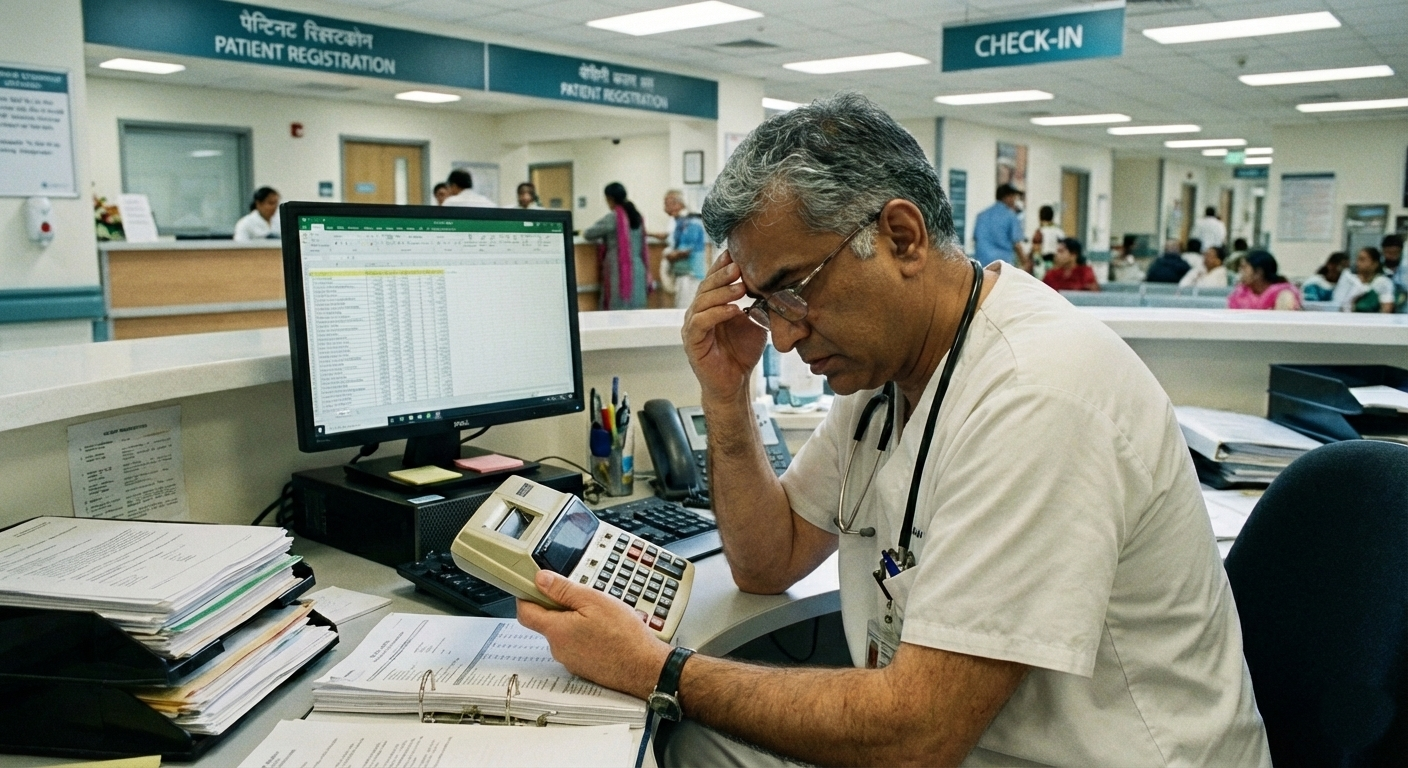

If you practice medicine in India, you already know what a typical day feels like. A waiting room that fills up before you've had your chai. Patients carrying plastic bags of old prescriptions and lab reports. Follow-ups that slip through the cracks—not because anyone stopped caring, but because there are only so many hours in a day.
This is the world AI is walking into. Not the robots of science fiction—something much quieter and friendlier. Think of it as a tireless assistant who reads, sorts, remembers, and gently points things out, so you don't have to carry it all in your head.
What AI Can Realistically Do for a Clinic Today
Forget the hype for a moment. The most valuable things AI does in healthcare are surprisingly unglamorous:
- It remembers, so you don't have to. A patient's full history—visits, labs, medications—organised and surfaced at the right moment, instead of buried in a paper file or someone's memory.
- It watches for what's easy to miss. A creatinine value drifting upward across three reports. A diabetic patient who hasn't returned in four months. A drug interaction in a long prescription list. These aren't hard catches individually—but at patient number fifty of the day, anyone can miss them.
- It takes the paperwork off your plate. Scheduling, reminders, notes, summaries. Ask any doctor what wears them down, and it's rarely the medicine—it's everything around it. That's exactly the part AI handles best.
When we built these capabilities into Arogyam.ai, the goal was never a smarter doctor—you're already that. The goal was a less exhausted one, with fewer balls to keep in the air.
The Real Prize: Catching Problems Before They Become Emergencies
Most life-threatening complications don't appear out of nowhere. They announce themselves quietly—a missed follow-up, an abnormal trend, a symptom mentioned in passing and never recorded.
AI is good at exactly this kind of quiet pattern. It can flag the post-surgical patient whose reports suggest a brewing infection, or the hypertensive patient whose readings have crept up over months. It doesn't diagnose. It taps you on the shoulder and says, "You might want to look at this one."
But Let's Be Honest: AI Makes Mistakes
Anyone who tells you their AI is always right is selling you something. These tools make mistakes, and knowing where they tend to slip is part of using them well:
- The unusual cases. AI learns from patterns, so rare conditions and odd presentations are exactly where it's weakest—and where your clinical judgment matters most.
- Messy information. A blurry photo of a handwritten prescription, a half-complete history, a mislabelled report—feed AI the wrong thing and it will give you a confident, polished answer that's still wrong.
- What it simply can't see. The patient who looks fine on paper but "doesn't seem right" to you. No software sees what twenty years of practice sees.
The fix is simple: treat AI like a bright junior colleague, not an oracle. Let it draft, flag, and summarise—but you sign off. Before anything touches a clinical decision, glance at the original report yourself. And if a suggestion feels wrong, trust that feeling and dig deeper. The doctors who get the most from AI aren't the ones who trust it blindly—they're the ones who know exactly when not to.
Building Trust—With Yourself, and With Your Patients
Trust in AI isn't granted; it's earned in small steps. Start by using it for low-stakes work—scheduling, summaries, reminders—and watch how it performs. As it proves itself, extend it to clinical support, always with your review in the loop.
With patients, transparency works better than silence. A simple line—"I use software that helps me track your reports so nothing gets missed"—almost always lands well. Patients aren't afraid of doctors using technology. They're afraid of being reduced to a number. When AI gives you back time to actually look up from the screen and talk to them, it does the opposite.
Whatever tools you adopt, insist on three things: your patients' information stays private, every suggestion can be traced back to something you can check yourself, and the final call is always—visibly—yours.
The Honest Bottom Line
AI will not replace doctors in India. But it will change what a well-run clinic looks like: fewer missed follow-ups, less time on paperwork, earlier catches, and—if we do this right—doctors who go home a little less drained.
The technology is ready. The best path is to adopt it the way you'd onboard a promising junior: give it real work, check its output, expand its responsibilities as it earns them.
That's the future we're building at Arogyam.ai—not AI instead of doctors, but AI standing quietly behind them.
Have questions about bringing AI into your practice? Write to us at support@arogyam.ai—we read everything.