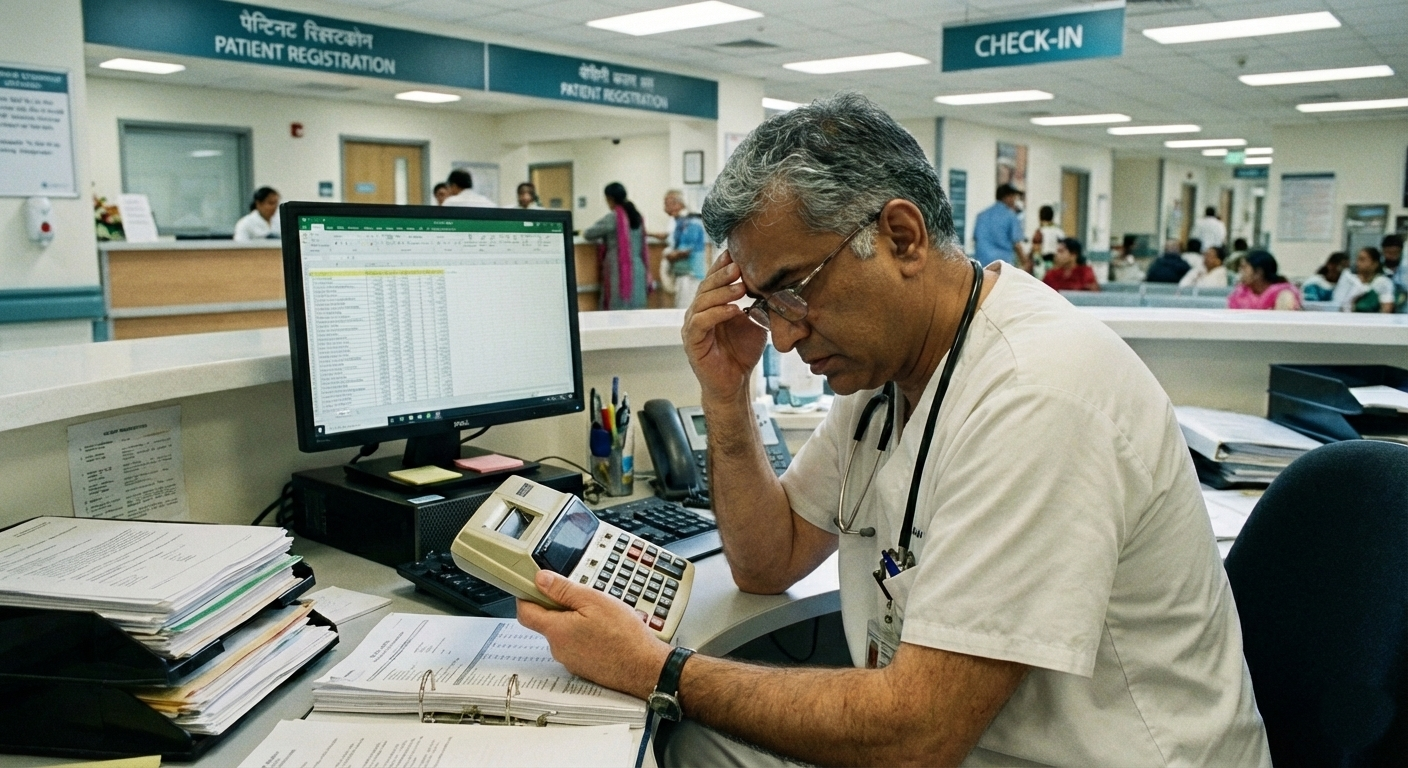

There's a comforting familiarity to paper. A quick scribble, a rubber stamp at the front desk, a file handed to the patient: "Keep this safe and bring it next time."
It feels simple. It feels free. But here's the uncomfortable truth: paper records have a very real cost. You just can't see it because the price isn't in what you spend on paper—it's in what happens when that paper isn't there.
Let's look at what this model is actually costing your practice.
The Biggest Cost: Your Patient's History Walks Out the Door
Most solo clinics in India don't maintain filing cabinets full of patient records. Instead, they hand the file back to the patient: "Keep this safe and bring it on your next visit."
It feels practical. No storage headache, no file clerks, no back room full of dusty folders. But here's the problem: you've just outsourced your medical memory to a person who might lose that file, forget it at home, or never come back with it.
What Happens When the File Doesn't Come Back
Be honest—how often does this happen in your clinic?
- Patient returns after 3 months. No file. "I couldn't find it, doctor."
- Patient switches from another doctor and has no records at all.
- File comes back, but the old prescription slip fell out or the lab reports are missing.
- Patient remembers they're "on some BP tablet" but can't recall the name or dose.
For a busy solo practitioner seeing 40 patients a day, even if 30% are returning patients and half of those come without complete records, that's 6 patients every day where you're flying partially blind.
That's 6 consultations with incomplete information. Every single day.
What Missing Records Actually Cost You
This isn't about filing cabinets. It's about what happens when the data isn't there.
Starting From Scratch — Every Time
When a returning patient walks in without their file, the consultation resets to zero:
- History retake: 3–5 extra minutes per patient, and you're relying on what the patient remembers (which is often incomplete or inaccurate)
- No medication trail: Was the last prescription working? Were there side effects? Nobody knows for sure.
- No baseline data: Previous vitals, test trends, chronic disease progression—all gone.
For 6 patients/day, that's 18–30 minutes of extra history-taking daily—time that produces no new clinical value. Over a month, you've lost nearly 2 full working days just recreating information that once existed.
Repeat Tests Your Patients Shouldn't Be Paying For
Without prior records, doctors instinctively play it safe—and rightly so. But the cost falls on the patient:
- "When did we last do your blood work?" — the patient doesn't remember, the old report is lost, so you order it again.
- "What dose were you on?" — nobody's sure, so you start conservative and lose a follow-up cycle.
- "Any allergies?" — it was noted in the old file. The old file is gone.
Studies in Indian healthcare settings show that 15–20% of diagnostic tests ordered in OPDs are avoidable repeats, driven primarily by inaccessible prior records.
For a clinic ordering an average of ₹800 worth of tests per patient, even a 10% repeat rate across 30 patients/day means:
₹800 × 10% × 30 × 26 days = ₹62,400/month in unnecessary tests.
Your patients bear the cost. And over time, they notice. "Why do I keep doing the same tests every time I come here?" That frustration quietly erodes trust.
The Patient Retention Problem
Here's the cost that doesn't show up on any bill: the patient who doesn't come back.
When a patient feels like every visit is a fresh start—repeating their history, redoing tests, explaining their condition from scratch—they don't feel known. They feel like a number.
Contrast that with: "I see your BP has been trending down since we adjusted your medication in September. Let's check if we can reduce the dose."
That's continuity of care. That's what makes a patient stay with a doctor for years. And with paper files that live in the patient's cupboard (or don't), that continuity is almost impossible to maintain.
A clinic that remembers its patients retains its patients. One that starts from scratch every visit loses them to the clinic that doesn't.
The Illegibility Problem
Let's address the elephant in the room: handwriting.
A prescription that the pharmacist can't read isn't just readability issue—it's a patient safety issue. The WHO estimates that medication errors affect 1 in every 30 patients, and poor documentation is a leading contributor.
With paper records:
- Prescriptions are misread at the pharmacy
- Nursing staff misinterpret dosage notes
- Referral letters arrive incomplete or unclear
- Medico-legal records are difficult to defend
One adverse event from a misread prescription can cost more in legal liability and reputation than years of stationery savings.
The Invisible Admin Overhead
Even without a filing cabinet, paper adds friction everywhere:
- Front desk manually writing patient details into a register every visit
- End-of-day tallying of billing registers
- No way to quickly pull up "how many diabetic patients did I see this month?"
- Referral letters written by hand, photocopied, sometimes lost in transit
The time spent on this manual work doesn't feel like a cost because it's spread across every hour of every day. But it adds up to hours per week that could go toward seeing more patients or simply going home on time.
The Costs That Are Coming
Even if you're comfortable with your current paper setup, two forces are changing the equation.
1. ABDM and Digital Health Mandates
India's Ayushman Bharat Digital Mission (ABDM) is building a connected health ecosystem. ABHA IDs, digital health records, and e-prescriptions are moving from optional to expected.
Clinics that can't generate or receive digital records will increasingly find themselves outside the ecosystem—unable to accept digital referrals, share records with specialists, or participate in government health schemes.
This isn't a distant future. ABHA registrations have already crossed 60 crore. The infrastructure is live.
2. Patient Expectations
Patients are already booking cabs, ordering food, and managing banking on their phones. The expectation of a digital experience is migrating to healthcare.
A clinic that hands out a paper chit and says "come back in 2 weeks" competes poorly with one that sends a WhatsApp summary, a digital prescription, and an automated follow-up reminder.
Patient retention is increasingly tied to patient experience, and experience is increasingly digital.
Adding It All Up
Let's total the annual cost for a typical solo practitioner seeing 40 patients/day:
| Cost Category | Annual Estimate |
|---|---|
| Wasted consult time (repeat history) | ₹72,000–₹1,50,000* |
| Avoidable repeat tests (patient cost) | ₹3,00,000–₹7,50,000 |
| Admin and manual overhead | ₹60,000–₹1,20,000* |
| Stationery (pads, printing, registers) | ₹30,000–₹75,000 |
| Total | ₹4,62,000–₹10,95,000 |
*Valued at ₹100/hour for staff time
That's ₹4.5–11 lakhs per year. For a mid-sized clinic with multiple doctors, multiply accordingly.
And this doesn't include the hardest cost to measure: the patients who quietly stopped coming back because they didn't feel remembered, the misread prescription that led to a complication, or the referral that never reached the specialist.
"But Digital Systems Are Expensive"
This is the most common objection, and it deserves a straight answer.
Yes, digital systems have costs—subscription fees, training time, an initial learning curve. But compare:
Paper costs are recurring, growing, and invisible.
Digital costs are predictable, shrinking, and visible.
A modern healthcare platform costs a fraction of the hidden paper bill. And unlike paper, it gives you something back: data, speed, compliance, and insight.
The question isn't "Can I afford to go digital?" It's "Can I afford not to?"
The First Step Isn't Software—It's Awareness
You don't need to overhaul your clinic overnight. Start here:
- Count "no file" patients for one week. How many returning patients show up without their previous records? The number will surprise you.
- Count your repeat tests. Ask your lab or pharmacy how often patients say "I did this test recently but I don't have the report."
- Notice the repeat history. How many times a day do you ask a returning patient to tell you their story from scratch?
- Ask yourself: For your chronic patients—diabetes, hypertension, thyroid—can you see their trend over the last 6 months right now? Or would you need them to bring in every old slip?
Once you see the numbers, the path forward becomes obvious.
Where Arogyam.ai Fits
We're building Arogyam.ai to solve exactly this problem—specifically for solo practitioners and mid-sized clinics in India.
Not a bloated hospital EHR. Not a system that needs an IT department. A platform that:
- Remembers every patient so you never start from scratch again—even if the patient forgot their file
- Tracks medication history, test trends, and visit notes in one timeline you can pull up in seconds
- Generates digital prescriptions that are clear, compliant, and shareable via WhatsApp
- Integrates with ABDM so you're ready for India's digital health future
- Runs on the devices you already have—no special hardware required
The goal is simple: your clinic should know its patients better than a paper file in someone's cupboard ever could.
Paper Served Its Purpose. It's Time to Move On.
Paper records aren't evil. They carried Indian healthcare for decades. But the model of handing a file to a patient and hoping it comes back intact next time—that's not a records system. It's a gamble.
The clinics that thrive in the next decade won't be the busiest ones. They'll be the ones that remember their patients, spot trends early, and deliver care that feels continuous—not episodic.
The real cost of paper isn't what you spend on it. It's what you lose when it isn't there.
Curious about what a paper-free workflow looks like for your clinic? Reach out to us at support@arogyam.ai or visit arogyam.ai to learn more.